


Arnauld Chevallier
Arnauld Chevallier
Introduction
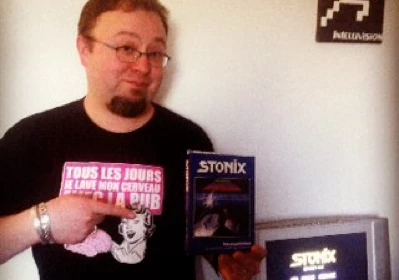
Arnauld Chevallier is a little-known but talented programmer from the Atari ST era. Using STOS BASIC, he created two games, RGB and Magenta, in the early 1990s. Although his early games remain obscure, Chevallier later became known for his work on the Intellivision. Today, his Atari ST creations offer a fascinating glimpse into the history of homebrew game development.
Profile
There is currently no profile available in our database
Arnauld Chevallier Interview
Written by grams88
August 18, 2026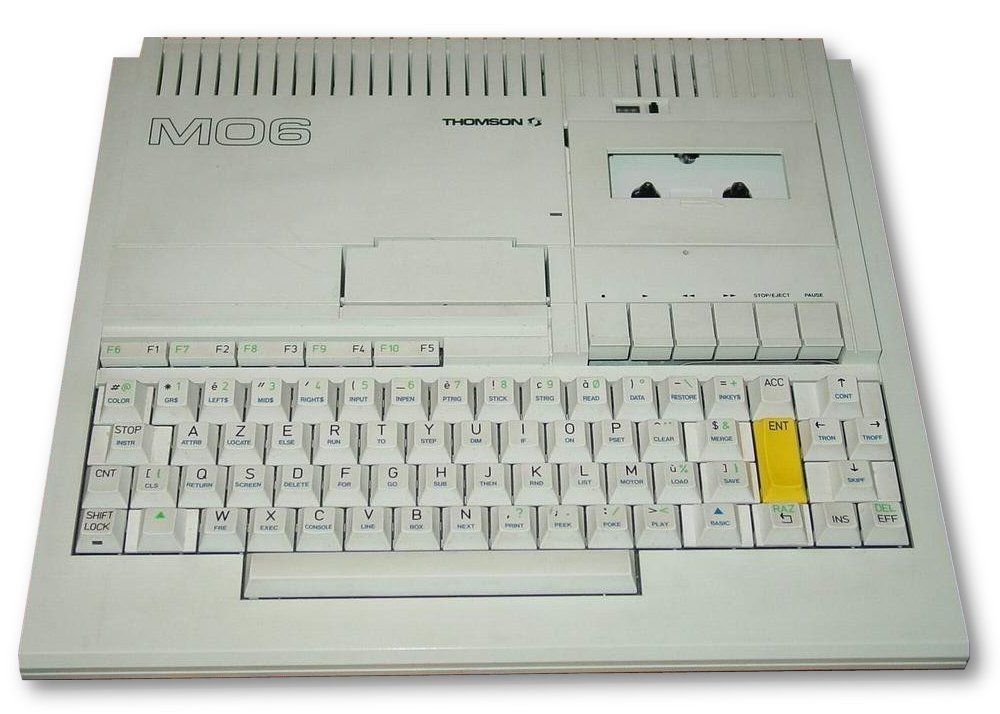
The Thomson MO6 was Arnauld's first home computer.
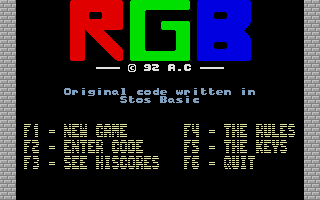
While GFA Basic remained rudimentary, especially when working with music and soundeffects, STOS was the solution for Arnauld. And thus, his first game was born ... RGB.
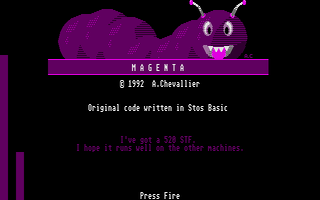
Magenta was his second game. A snake clone. However, the gameplay was not balanced, making the game more frustrating than enjoyable, according to Arnauld.

Guns 'n Roses
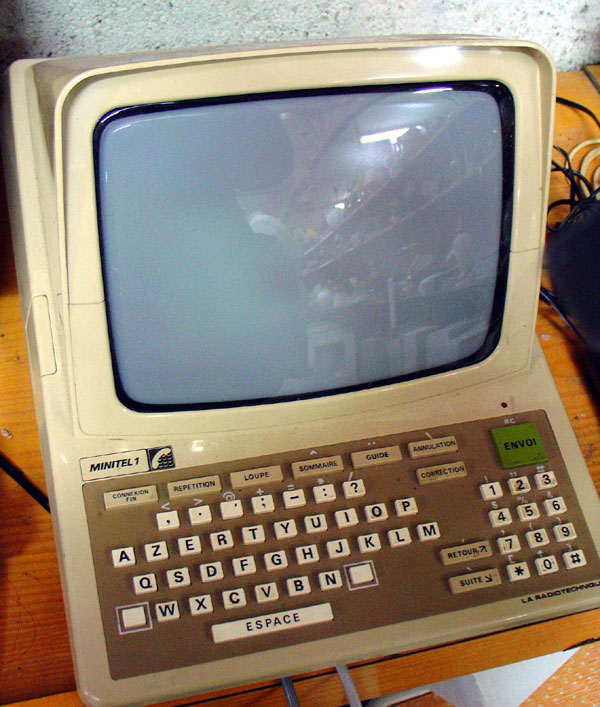
The Minitel 1

K.I.T.T. - the legendary Pontiac Transam from the Knight Rider series, one of Arnauld's favorites.
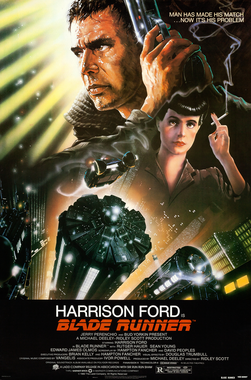
One of the best sci fi movies ever...

Alan Turing
1) Hi Arnauld, would you be able to give us a quick introduction to those of us that have not heard about you before?
Hello, and thank you for inviting me to this interview. I am a software engineer, and I have been interested in computing since childhood. My very first video game console was the Intellivision. Later, my first computer was a Thomson MO6, which I got around the time of France's "Computing for All" initiative in 1985. A little later still, I got an Atari 520 STF; that was the machine on which I truly began creating things of my own, and it gave me some of my most memorable computing experiences.
2) One of the games you worked on was a game called RGB which looks really nice and I love the colours as it brings things to life in a sense. Would you be able to describe what the objective of the game is as well as telling us a little bit about what gave you the idea to go and create the game?
Each level contains a set of colored blocks that must be merged to produce specific colors and activate special blocks. Sometimes, you must use other mechanisms—such as moving platforms and stone blocks—to build a path. Color merging follows the principles of additive color mixing, such as red + green = yellow. As for the initial idea, I must admit I no longer remember where it came from; it likely occurred to me while I was experimenting with additive color mixing in a drawing program or in BASIC.
3) STOS Basic is a very nice tool for creating some wonderful games, how did you find the programming and using stos basic? It takes a bit of learning to get used to STOS basic if that's a fair thing to say.
I had a pretty disastrous initial experience with the "ST Basic" that came with the machine. I found it slow and poorly designed, and it didn't meet my expectations at all. It was a great relief to discover GFA Basic, which made it possible to code all sorts of things much more efficiently. However, the games I was creating in GFA remained quite rudimentary, especially regarding music and sound effects. I therefore wanted to try a specialized language—namely, STOS BASIC. I should point out that, at the time, I didn’t know assembly language. In fact, one of my regrets is that I didn't learn 68000 assembly until several years later. Of course, it is through assembly language that you can unlock the machine's true potential. Mixing GFA with a few specialized assembly routines would have been a good alternative to STOS.
4) I noticed the levels in the game have a time limit where you have to complete things very fast as well as two or three lives if I have that correct. What was your feeling about the time limit and the lives?
Well, the time limit makes things a bit more challenging! That naturally goes hand in hand with a limited number of lives. However, the game has a password system, with codes issued at certain checkpoints, so you don't have to start again from the beginning.
5) I usually like asking this question, were you able to complete the game yourself? I noticed sometimes the creators of the games aren't really gamers themselves if that's fair to say.
I like to thoroughly test my games and ensure that the gameplay is solid and everything is achievable. So yes, I've definitely completed the game, probably several times. But since I play it a lot during development, I might tend to find certain levels easy when, in reality, they aren't quite that easy.
6) The music in the game introductory screen is quite nice, how did you get on doing the music for the introduction to the game? I don't know if there was music when playing the game.
I believe that back then, I used to compose the music on a small Yamaha synthesizer first, before transcribing it into the dedicated STOS BASIC utility. By default, sound effects play during the game. However, there is an option to enable music instead.
7) There was another game you worked on as well in the past, I think it was called Magenta, another name of a colour, I like that. What was the objective of the Magenta game?
Magenta is basically a single-player clone of Snake. The name "Magenta" simply comes from the color of the creature controlled by the player. However, I don't think I quite got the gameplay balance right this time. The game requires very precise timing, and I think that makes it more frustrating than enjoyable.
8) Could you tell us more about your BBS server Apogee?
Apogee was a single-line BBS that I wrote entirely in GFA Basic. It ran on my Atari 520 STF, connected to a Minitel 2, from my home in Boulogne-sur-Mer. I didn't even have a hard drive, so the whole thing ran from floppy disks. My sysop name was Axl. Yeah, I was a big Guns N' Roses fan at the time.
It was quite a modest setup, but I kept the machine running 24/7 for several months. Eventually, the ST's power supply gave up. Fortunately, one of my regular users kindly gave me a spare power supply, which allowed me to get Apogee back online. I remember that quite fondly, because it was a nice illustration of the community around these systems: people weren't just connecting to a server, they actually knew and helped each other.
9) Are you working in the games industry these days or doing something different? The video games industry looks really fun to work in.
No, I don't work in the gaming industry, and I’m not sure it’s quite as romantic as it may look from the outside these days, except perhaps in smaller companies. That said, I would have loved to work in this sector in the 80s or 90s—whether on the Commodore 64, Atari ST, Amiga, or Game Boy, among others.
However, I continue to write games for the Intellivision today—this time entirely in assembly language—some of which are released in physical format. My most popular titles are Stonix (a breakout game) and an official port of Defender of the Crown, mostly based on the Atari ST version. But it's just a hobby, and it's not how I make a living.
10) I really like my TV shows and some films, are you into your films and TV shows yourself and what would your top picks be if you are into them?
I'm not particularly interested in keeping up with current TV series. I do watch some from time to time, though—shows like Sherlock, The Last of Us, or Fallout. But I admit I prefer rewatching old episodes of Columbo, Knight Rider, or The Prisoner for the umpteenth time. As for movies, I have a preference for sci-fi, thrillers, and sometimes a bit of horror. My all-time favorite movie is undoubtedly Blade Runner. This probably resonates with a certain famous French cracking group on the Atari ST scene. Let's call it The Reps. :-)
11) I'm a big fan of board games and being able to play board games on the computer is very fun, are you a fan of board games yourself and if you are, what would your favourites be?
I used to play backgammon on NetGammon, which was a popular and quite friendly platform at one time. I also played a few games of chess and Scrabble, but only very occasionally. Does Windows Minesweeper count too? ;-)
12) Keeping to ST Graveyard's style, he usually asks this at the end of the previous interviews so here I go. If you could have a drink with anyone, dead or alive, who would it be and what would you ask?
I would probably choose Alan Turing. I'd love to ask him what he would make of today's AI, and in particular whether he would consider the Turing Test to have been passed now that machines can convincingly fool people into believing they are human.
Latest Interviews
Arnauld Chevallier
August 18, 2026 by grams88
Arnauld Chevallier is a little-known but talented programmer from the Atari ST era. Using STOS BASIC, he created two games, RGB and Magenta, in the early 1990s. Although his early games remain obscure, Chevallier later became known for his work on the Intellivision. Today, his Atari ST creations offer a fascinating glimpse into the history of homebrew game development.
Wayne Smithson
April 5, 2026 by grams88
Wayne Smithson was part of the Psygnosis family and has always had a fondness for the Atari ST and fast-paced shooters. The crown jewel of his work is undoubtedly Anarchy. To this day, Wayne remains active in the industry, though the most exciting times were during the glory days when the Amiga and Atari ST dominated the computer landscape.
Pete Lyon
March 29, 2026 by grams88
With the release of fast-paced classics like Goldrunner and Return to Genesis, Pete, alongside the late Steve Bak, formed part of 'the dream team'. Widely regarded as a pioneering graphic designer for the Atari and Amiga during the 1980s and 1990s, Pete contributed visuals to numerous titles, including Airball, Leatherneck, Eliminator, Karate Kid part 2, and many others.
Martin Brownlow
August 5, 2025 by grams88
Martin Brownlow is a living legend. Best known among ST fans for creating the beloved PD/shareware classics Grav and Grav 2, his games are still cherished by many to this day. From a young age, Martin knew he wanted to make games for a living...and he made that dream a reality. In fact, he’s still doing it today. Discover the full story and much more in this exciting new interview.
Stacey Jamieson
October 4, 2024 by grams88
Stacey Jamieson began his career at DMA Design, working on titles such as Oh No! More Lemmings, Walker, GTA and others. Over the years, he moved on to Electronic Arts (EA), where he contributed to major games like the Star Wars Battlefront series, Mass Effect, and Need for Speed. Today, he is the co-founder of Expression Games, where he continues to pursue his passion for game development. What an exciting career!